

 0
0 0
0 0
0 20 May 2026
On May 15, we hosted the “Usemaps for Renewable Energy Developers” webinar, during which we showed how to organize spatial data workflows and streamline the investment process in renewable energy projects. The meeting focused primarily on practical aspects of working with spatial data, investment site analysis, and managing project information within a single environment.
One Platform Instead of GIS Chaos
One of the main topics of the webinar was the problem of fragmented data in companies involved in renewable energy project development.
In practice, information is often spread across Excel spreadsheets, local GIS projects, shared files, and email communication. As a result, teams work with different versions of data, collaboration between departments becomes more difficult, and finding the right information takes significantly more time.
During the webinar, we showed how Usemaps helps organize this process by creating a single, up-to-date source of information for the entire team.
Renewable Energy Project Management and Team Collaboration
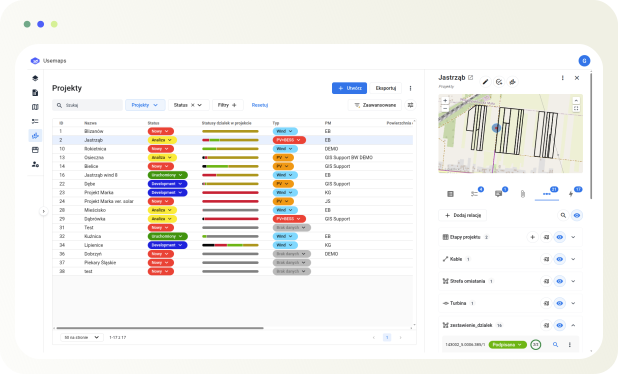
During the webinar, we presented, among other things, the project panel, which allows teams to manage investments, tasks, documentation, and spatial data in one place. We also showed how relationships between projects, land plots, and landowners can be organized, as well as how teams can move more efficiently between related pieces of information.
We also focused on collaboration between project teams and GIS specialists. Usemaps does not replace tools such as QGIS, but extends their capabilities across the entire organization. This allows non-technical users to work with up-to-date spatial data without needing to use specialized GIS software directly.
See More
We have also prepared short materials showing how Usemaps supports renewable energy projects – from project management and creating new investments to spatial data analysis.
Location Analysis and Investment Site Search Engine
During the webinar, we also presented practical examples of data workflow automation. One of them was the automatic retrieval of land plot information and the calculation of selected location parameters, such as the distance to a GPZ substation or protected nature areas.
An important part of the webinar was also the investment site search tool. The solution allows users to analyze locations based on selected criteria, such as distance from infrastructure, land plot size, or environmental constraints. As a result, potential investment areas can be identified quickly without the need for multiple manual analyses.
See It in Practice
Watch a short video showing how the investment site search tool in Usemaps works and how location analysis can be performed using selected spatial criteria.
Ready-to-Use Data Layers for Renewable Energy Projects
During the webinar, we also presented the capabilities of Data.Box – a collection of ready-to-use data layers supporting renewable energy projects. It includes, among others, flood risk data, land ownership information, and land use classifications, which can significantly accelerate the location analysis process.
DziękThanks to ready-to-use and optimized data layers, teams can move faster to the actual investment analysis stage without the need to independently collect and prepare data from multiple sources.
Explore Available Data.Box Layers
Data.Box includes ready-to-use data layers supporting location analysis and renewable energy projects – from environmental data to land ownership and infrastructure information.
Public Wind Energy Constraints Map
At the end of the webinar, we also presented a public map of location constraints for onshore wind energy development.
The tool makes it possible to analyze how environmental and spatial constraints affect the availability of investment areas and shows how quickly the amount of land suitable for renewable energy projects decreases once specific conditions and buffer zones are applied.
Explore the Renewable Energy Constraints Map
Explore the public map of location constraints for onshore wind energy development and see how individual constraints affect the availability of investment areas.
Thank you to everyone who participated in the webinar, as well as for the questions and conversations after the meeting.
If you would like to see how Usemaps can support renewable energy projects in practice, feel free to contact us and schedule a short platform presentation.