eye 0thumbs up 0thumbs down 0clock 3 April 2026
Usemaps Retail - for retail

Your analysts spend weeks analyzing the surroundings of locations that a land hunter should have rejected in five minutes.

Retail tools are mainly platforms for catchment analysis, sociodemographic data, and sales forecasting. Good tools - but they support only one part of the expansion process. Beyond analysis, you need to sift through hundreds of land offers, conduct due diligence, negotiate terms, and convince the investment committee. All of this happens in Excel files, emails, and in the minds of land hunters, who may be working for a competitor a year from now. Usemaps is a platform for the entire expansion process - not just its final step.

Challenges

Retail network expansion is not a single decision. It is hundreds of parallel processes that no one sees in full.

Catchment analysis for a poor location is the most expensive loss in the entire process.

A catchment specialist is a rare and expensive resource. Each full analysis - demographics, drive-time area, competition, traffic generators - takes their time, measured in days. If a location is rejected after the analysis due to a factor that should have been visible at the initial screening stage, that time has been wasted. The bottleneck is built into the process: too few specialists, too many locations to filter.

You have a land bank. The problem is - it’s not a bank, it’s a graveyard of data.

An Excel file with a thousand rows, multiple versions across different people, and statuses that no one updates. You can’t see where these plots are in relation to each other, to your stores, or to the competition. You can’t see the white spaces worth entering. You can’t see which areas have been analyzed and which remain untouched. The data exists - but it doesn’t work for you.

The land hunter has left. Along with them went half of your market knowledge base.

They knew which landowners were willing to talk and which were not. They knew why that plot by the bus stop was removed from the list two years ago. They knew which village head was blocking all investments in the municipality. None of this is in the system - because the system is just a folder on a drive and contacts in a phone. When a new land hunter starts, they start from scratch. And plots that were rejected for a specific reason return as fresh proposals.

Every network has its “secret knowledge” of what drives traffic. And no one maps it.

For one network, the key driver is a church - sales peak after mass. For another, it’s a school, a market, a bus terminal, or a roadside marketplace. This knowledge exists - but it lives only in the minds of experienced analysts and expansion directors. Each new location is evaluated through this knowledge only when the right person has time to assess it. There is no system that stores and applies this knowledge.

The investment committee makes decisions based on a PDF put together at the last minute.

The entire effort of the expansion process - months of work by land hunters, due diligence, negotiations, and analysis ends up in a PowerPoint presentation someone puts together over the weekend before the meeting.
There is no single place where a decision-maker can see the location’s history, documents, analysis results, and current status at the same time. A multi-million-zloty investment decision is made based on slides with JPEG maps.

Due diligence is a race against time conducted in chaos.

Land ownership, local zoning plans, road access, connection conditions, history of administrative decisions, lease agreements - these are pieces of information from a dozen sources, gathered from scratch each time and stored in a separate folder for each location. When the investment committee asks for the status of five locations at once, someone spends a week putting together a presentation instead of looking for new land.

How does Usemaps address these challenges?

From the first land offer to the investment committee decision - everything in one place.

A land bank that builds knowledge - not just collects data.

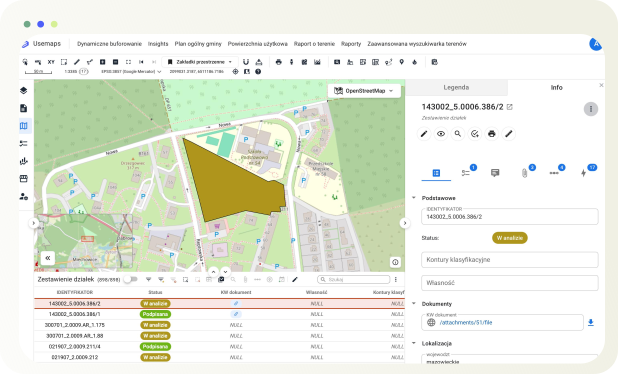
Every location you consider - even one rejected five years ago - has its place in Usemaps with a full history: who analyzed it, when, why it was rejected, what agreements were made with the owner, and what the authorities said. When the same plot returns as a “new” proposal, you already have the answer. Market knowledge stays within the company, even if a land hunter moves to a competitor.

Your secret knowledge of local traffic drivers becomes a system resource.

Churches, schools, markets, bus terminals, local community centers - we can provide these data or help build them as a custom layer tailored to your network model. A land hunter starting in a new region immediately has access to the knowledge their predecessors built over years. Initial location evaluation no longer depends on who happens to be available.

Catchment analysis is the final step of a well-prepared process, not a last-minute fix.

Classification contours, cadastral parcels, soil-agricultural maps, air zones, land ownership data, and more. 40+ consistent, ready-to-display layers with automated analysis.

The investment committee sees everything - without a PowerPoint put together over the weekend.

One location in Usemaps equals one view: map, history, documents, catchment analysis results, negotiation status, and contacts. A decision-maker clicks a link and gets the full picture - no presentations, no emails with attachments, no asking “which version is current?” Investment decisions are made based on facts - not on how well someone can put slides together.

Specialized tools

Every retail location has unique potential. Our solutions help you discover, analyze, and fully capitalize on it.

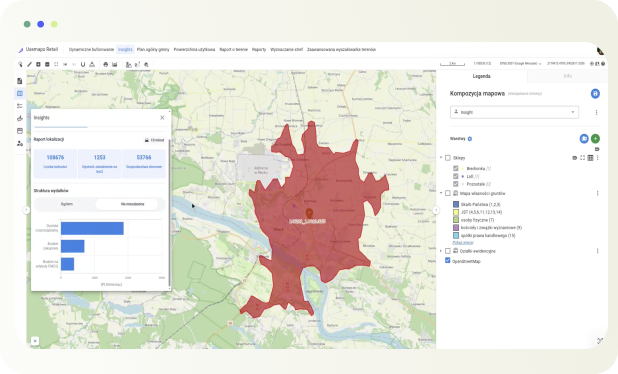
Retail location analysis

Usemaps provides information to support better decisions:
Plus, you maintain a complete analysis history. Work efficiently and strategically.

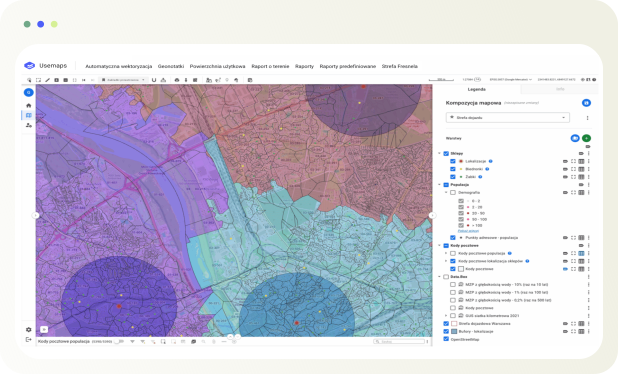
Delivery zone optimization

With Usemaps, you won't miss a single opportunity:

We have answers to every question

We currently use QGIS. Can data from QGIS be transferred to Usemaps?

Yes. No problem. All data can be imported into Usemaps. Then it can be used in the browser environment, through the QGIS plugin, and in the mobile app.

Yes. Usemaps can be deployed on-premises at your company, on our servers, or in any data center – including AWS, Azure, or other cloud platforms.

Request a quote

We will answer all your questions

Ask
for price

Ask
for price