
 0
 0
 0
 12 October 2026
Use Case – TEN-T Data Reporting
How CEUTP Organized TEN-T Data and Automated Reporting to the European Commission

Challenge
CEUTP (Centre for European Union Transport Projects), acting on behalf of the Ministry of Infrastructure, is responsible for reporting on the Polish section of the Trans-European Transport Network (TEN-T). The network data is not created within CEUTP itself, but is distributed across dozens of entities, including road and railway infrastructure managers, seaports and inland ports, airports, and intermodal terminals. Each infrastructure manager collects network data according to its own needs and guidelines, using different formats and update cycles.
Previously, the data used to feed TENtec, the European Commission’s (EC) information system, was collected on an ad hoc basis by the EC services and then verified by the relevant national institutions. To streamline the process of transferring data to the EC, a new approach was developed under which Member States are responsible for preparing a tool that enables the automatic exchange of TEN-T data between TENtec and national systems across all modes of transport. Ultimately, the data is expected to be transferred to TENtec via API in a strictly defined structure.
Previously, the data used to feed TENtec, the European Commission’s (EC) information system, was collected on an ad hoc basis by the EC services and then verified by the relevant national institutions. To streamline the process of transferring data to the EC, a new approach was developed under which Member States are responsible for preparing a tool that enables the automatic exchange of TEN-T data between TENtec and national systems across all modes of transport. Ultimately, the data is expected to be transferred to TENtec via API in a strictly defined structure.
Solution
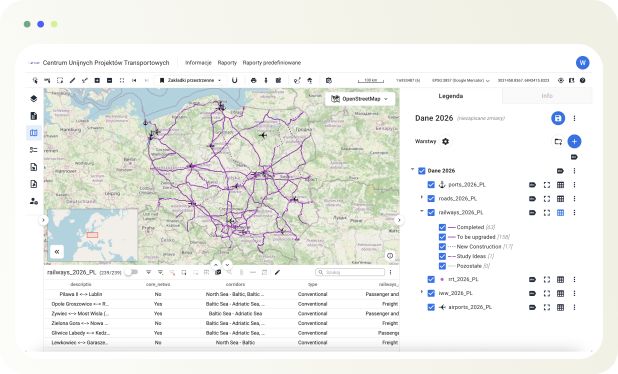
CEUTP implemented Usemaps as a single place for collecting TEN-T infrastructure data from all infrastructure managers within the network. Each network asset has its own spatial representation and a complete set of attributes required for reporting.
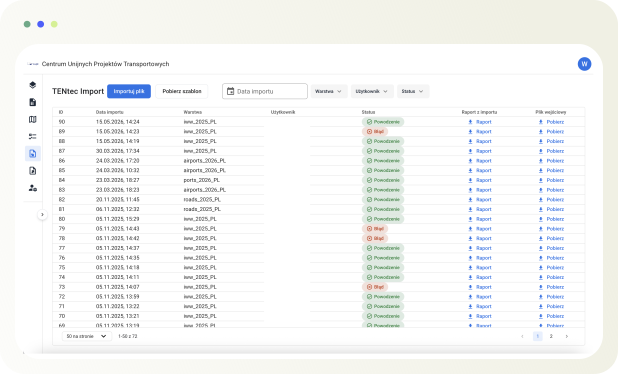
DWe added two custom modules to the standard platform. The first supports data collection from operators: each infrastructure manager works with its own section of the network. They prepare a report in a predefined format or download a template from the system, complete it, and upload it back. The validator checks the submitted report and, if any errors are found, returns a file listing the inconsistencies that need to be corrected. Every change is recorded together with the author and date, so CEUTP can see in real time what has been updated, by whom, and when.
The second module is responsible for preparing the data in the structure required by TENtec. Once a report has successfully passed validation, it is sent to TENtec as a data package via API. Only data that has already been verified is transferred to the European Commission’s system, and the entire process is fully automated, requiring no manual work.
As a result, a process that previously relied on a series of information exchanges has been transformed into a single data workflow within one system, with a complete change history and visibility at every stage.
Results
CEUTP has full control over the data submitted by infrastructure managers. It can see which data is complete, which still requires additional information, and when it was last updated. Verifying this no longer needs to be a separate task carried out before each reporting cycle.
Reporting to the European Commission is no longer a project in itself, but a routine task. The system always contains the most up-to-date data available, so exports to TENtec can be performed on demand, at any time, rather than only according to the schedule defined by the data collection cycle.
Reporting to the European Commission is no longer a project in itself, but a routine task. The system always contains the most up-to-date data available, so exports to TENtec can be performed on demand, at any time, rather than only according to the schedule defined by the data collection cycle.
