

 0
0 0
0 0
0 15 January 2026
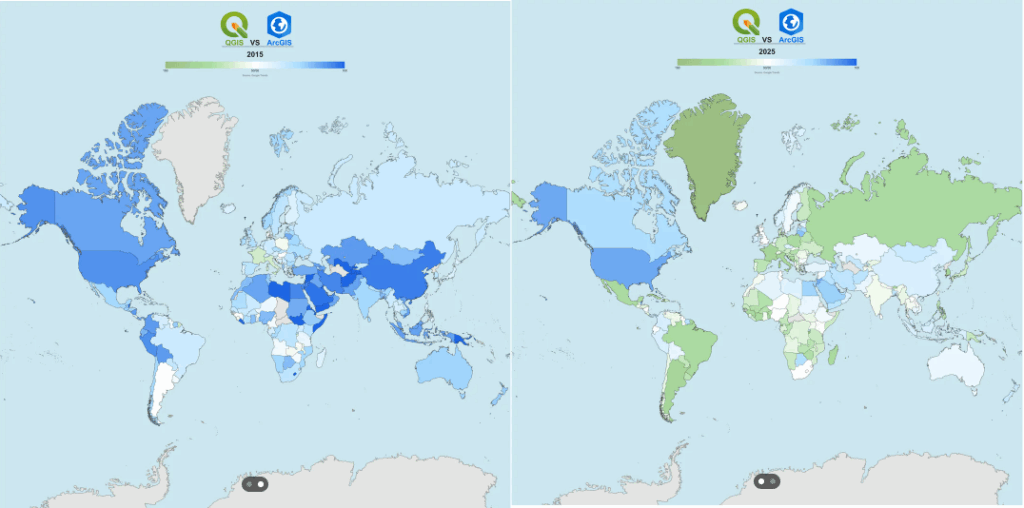
For the past few days, the following map, created by a Reddit user, has been circulating on social media.
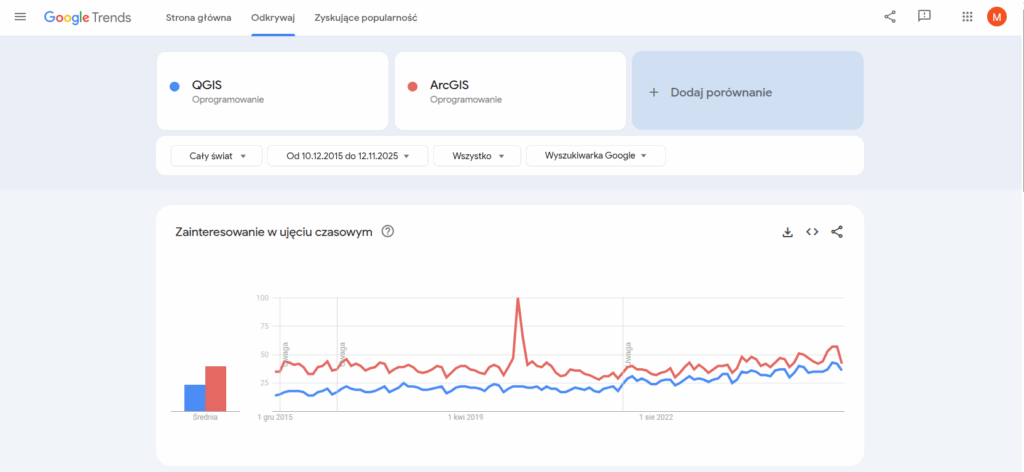
It shows a comparison of interest in the terms QGIS and ArcGIS in 2015 and 2025 on Google Search. The Google Trends tool is publicly available and very easy to use, so anyone can verify this data (I spent about fifteen minutes doing it).
I have an ambivalent attitude toward this data.
➡️ The “flood of green” in 2025 suggests that QGIS has taken over half the world by storm, but looking at the chart, you can see that QGIS is still less popular (though the gap is closing), and both terms are on an upward trend.
➡️ Comparing QGIS and ArcGIS is like comparing apples to pears. QGIS is primarily desktop-based (with a growing ecosystem of apps like QGIS Server, QField, etc.). ArcGIS, on the other hand, is an entire environment, where desktop software (e.g., ArcGIS Pro) represents a shrinking part of the whole system.
I believe that in the desktop software segment alone, considering price, usability, and customization capabilities, QGIS is unmatched.
However, a more systemic approach—where deployment time, security, centralized system administration (including SSO), integration with other systems, and minimizing custom software matter—is… a different league.
And in this league plays Usemaps—a next-generation platform for managing map-based data.
In the example above, Usemaps becomes a secure, scalable, “battle-tested,” central element of the system, responsible for data storage, user authentication, and controlling the entire setup. Users can connect via QGIS (soon also ArcGIS Pro!) or work through the web browser and mobile app.